

Roll Roller crusher operation manual install mantain guide,replace roller skin
2026-03-12
Goldwen Tech
As roll crusher / roller crusher manufacturer , we will introduce its operation manual:
1.how to install roller crusher
2.how to test roll crusher
3.how to opreate roller crusher
4.maintenance of roller crusher
5.how to replace the roller skin
Related products:
roll crusher , four roller crusher
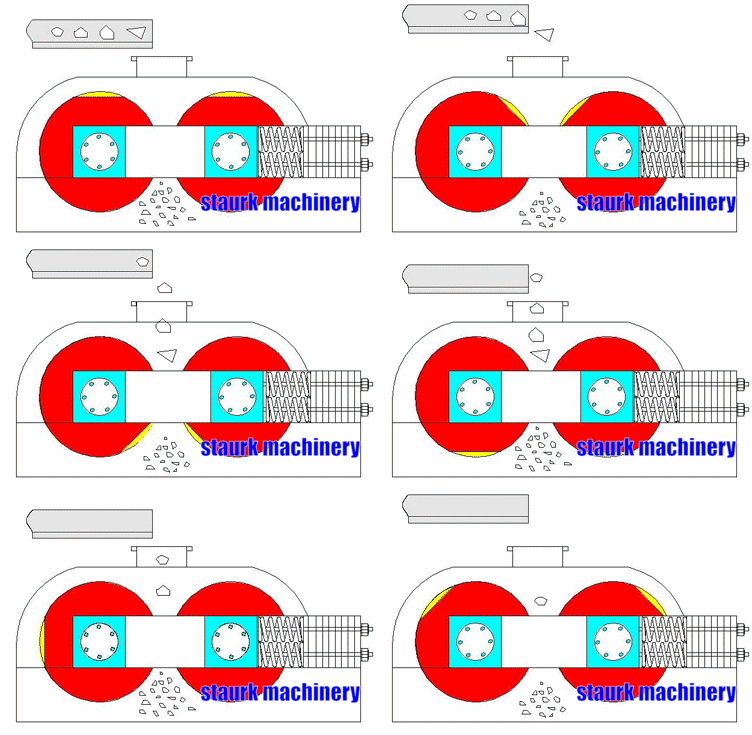
1.Install
1)Refer to the foundation drawings and foundation construction drawings, and install the machine on a specially designed basis.
2)In order to better withstand the uneven force generated by the machine when it is working, the bottom frame can be fitted with the sleeper strip, and the discharge position can be reserved.
3) After the machine is installed and the level is found, then the transmission part is installed according to the drawing
4)The drive belt should be adjusted to the proper position for tightness.
5)The pressure spring must be adjusted to the proper position.
6)Strictly check that there is no looseness in the solid parts.
7)This machine is supplied in a complete assembled form, but it is necessary to carefully check whether the machine is damaged during transportation or during long-term storage, and whether the sliding parts and rust are corroded, and the installation can be carried out after confirming that the machine is intact.
2.Commission
Test operation of the machine:
After the machine is installed, it must be tested before it is officially put into production.
1)Idling test:
The machine must be continuously idling for no less than 2 hours at the site of use. The temperature rise of the bearing shall not exceed 30 degrees during operation, and the maximum temperature rise shall not exceed 40 degrees. Gears, long gears, V-belt pulleys and rollers Part of the rotation is balanced, there is no abnormal noise, and there is no collision between the two rollers.
2) Load test:
The load running test can only be carried out on the basis that the empty running test has achieved good results, and the load test time shall not be less than 8 hours of continuous operation.
Determine whether the actual discharge particle size and output meet the requirements, and ensure that the bearing temperature does not exceed 35 degrees. All lubricating points must be filled with lubricating grease, the seal is good, and there is no leakage.
If it is found that the output or particle size does not meet the requirements during operation, it can be adjusted by adjusting the bolt at the rear end of the movable device. If the current fluctuation is found to be unstable during operation, it should be checked whether the feeding particle size meets the requirements. After the load test is normal, it can be put into operation. use.
3.Operation
In order to ensure the safe operation of the machine for a long time, special attention should be paid to the correct operation of the machine, as well as daily maintenance and regular maintenance.
(1)Preparations before run:
The machine must be fully prepared and strictly inspected before the normal operation.
And then start.
The machine itself requires that all parts must be intact, and all fixing bolts and anchor nuts should be firmly tightened , the machine accessories must not have things and sundries that hinder the operation.
(2)The sequence of start and stop
After the above preparations and inspections,fully meet the requirements,
the crusher can be started,
after the speed of the machine is normal.
Feed material into the machine
The feeding must be uniform, and the feeding of the machine should be stopped first when parking. , and wait until there is no remaining material in the feeding hopper before stopping the operation of the machine.
(3)The normal operation
After the machine is running normally, the operator of the machine and related personnel must pay attention to the following matters:
1. Check whether all fixing bolts are broken or loose.
2. Whether the lubrication of each bearing is normal and whether there is oil leakage.
3. Whether the seals are tight and whether there is oil leakage.
4. Whether the tonic amount is too much, and whether the discharge granularity meets the requirements.
5. Whether the operation of the rollers and gears is normal.
(4) Other matters need to be token attention:
1. Do not change the rotation direction of the machine.
2. When there is a power failure during the operation of the machine, the power supply should be cut off immediately to avoid accidents caused by sudden power calls.
4.Maintenance
1. No matter what method is used to feed the crusher, must remove iron , cannot feed iron or metal into the crusher
2. Check the oil level to ensure sufficient oil supply.
3. The crusher must be started with no load, and the retained materials in the crusher must be checked and removed before starting.
4. Start the crusher to reach the normal speed, and start feeding when there is no abnormality.
5. If the crusher is out of use for a long time, or it is started for the first time, the large pulley should be rotated by manpower for 2-3 weeks in advance to confirm that the machine runs smoothly, and then the motor will be "jogged" several times.
6. Regularly sample and check whether the particle size of the crusher product meets the requirements. The spacing of the crushing rollers is adjustable if necessary.
7. During normal shutdown, be sure to stop the feeding in advance, and the crusher can be shut down only after all the materials in the standby are removed.
8. The main and auxiliary transmission gearboxes of the crusher are lubricated with gear oil, and the lubricating oil in the box should be replaced in time during summer and winter.
9. When changing the strength, particle size or crushing ratio of the crusher material, the nitrogen pressure of the buffer cylinder should be re-adjusted. The size of the pressure is moderate to meet the needs of the crushing roller pressing force. Excessive pressing force will accelerate the wear of the parts and increase the power consumption. If the pressing force is too small, the super-grain of the crushed product will increase, and the movable crushing roller will frequently vibrate. The use range of nitrogen pressure in the buffer cylinder is 1.5-4MPa.
10. After the crusher is overhauled, when the upper crushing roller and the jacket coupling are reassembled, the tightening torque of the round nuts and coupling bolts should be strictly controlled. When tightening the clamp coupling bolts, pay attention to the sequence. The diagonal bolts should be tightened first, and then the middle bolts should be tightened. At the same time, pay attention to the uniformity of the gaps on both sides of the split surface of the coupling.
11. If the cover of the main and auxiliary transmission gearboxes needs to be opened for maintenance and repair, the rubber sealing strip must be replaced and a layer of sealant should be applied evenly on the static sealing surface before reinstallation to prevent oil leakage and oil leakage on the sealing surface. .
12. The bearings of the upper and lower crushing roller translation linkage devices of the crusher are lubricated with grease, and the design requires the use of No. 2 or No. 3 calcium-based grease. During normal production, the lid of the oil cup should be tightened for one week to inject grease every week of work.
5.how to replace the roller skin
Step 1: Safety preparation and shutdown (top priority)
Step 3: Install the new roller skin (core step)
Step 4: Trial operation and acceptance
Maintenance tips
If your equipment is outdated or has a complex structure, and you are not fully confident, it is recommended to contact the technical personnel of the equipment manufacturer for on-site guidance, or directly return the roller shaft to the factory for replacement. This is a more reliable and efficient approach.
5.how to replace the roller skin
Step 1: Safety preparation and shutdown (top priority)
Before starting any work, it is essential to ensure that the equipment is in an absolutely safe state to prevent accidental start-up and subsequent injury.
1. Cut off the power completely: Disconnect the main power supply to the double-roller crusher
2. System pressure relief: If the equipment is driven by a hydraulic system, pressure relief must be carried out first by pulling up the rope switch of the ore supply belt.
3. Cleaning the site: Remove the loose stones from the belt conveyor head and surrounding debris to ensure sufficient operating space.
4. Remove protective covers: Remove components that hinder operation, such as outlet protective covers, cover plates, and dust covers.
Step 2: Remove the old roll cover
This step requires careful operation to avoid damaging the roller body (mandrel).
1. Remove the fasteners: Use specialized tools (such as wrenches) to disassemble the bearing cover, nut, and the fixing bolts of the roller skin on the bearing seat.
2. Remove the old components: Remove the old roller skin. If the old lining plate is stuck or rusted due to long-term use and cannot be removed directly, gas welding can be used for cutting and removal if necessary, but care should be taken not to damage the surface of the roller body.
3. Cleaning inspection:
Thoroughly clean the residue, dust, and oil stains on the surface of the roller body.
Key inspection: Carefully inspect the roller body (mandrel) for wear, deformation, or cracks. If the roller body is damaged, it must be repaired first; otherwise, the new roller cover will quickly wear out due to poor fit after being installed.
Step 3: Install the new roller skin (core step)
1. Surface treatment: Clean the inner surface of the new roller cover to ensure it is free from oil stains and impurities, ensuring a tight fit with the roller body.
2. Alignment installation:
Smoothly fit the new roller skin onto the roller body, paying attention to the front and back directions (if there are specific tooth shapes or structures).
Adjusting the gap: During installation, special attention should be paid to maintaining a uniform gap between the two rollers. If the gap deviation is too large, it can lead to uneven particle size in the output material and exacerbate uneven wear of the roller skin.
3. Fixed connection:
Use bolts for preliminary fixation.
Tightening: Apply even pressure to tighten the fixing bolts or compress the nuts, and install the locking plate to prevent loosening.
Step 4: Trial operation and acceptance
Don't start production immediately after installation. A trial run is necessary.
1. No-load test run: Reconnect the power supply and start the crusher without any load.
2. Observation status:
Listen to the sound: Check if the equipment is operating smoothly, and if there are any abnormal sounds of impact or friction.
Check for vibration: Inspect the equipment for any severe vibration and confirm whether the roller skin is installed in a balanced manner.
Check current: Observe whether the reading on the ammeter is normal.
3. Production input: After confirming that everything is normal, gradually start feeding materials and enter the formal operation state.
Maintenance tips
Wear prevention: The feeding of materials should be uniform to avoid direct impact of large pieces of material on the roller skin, which can effectively extend the service life of the roller skin.
Regular inspection: During daily patrol inspection, pay attention to observe the wear condition of the roller skin. Once severe wear or circular grooves are found, timely measures should be taken.
If your equipment is outdated or has a complex structure, and you are not fully confident, it is recommended to contact the technical personnel of the equipment manufacturer for on-site guidance, or directly return the roller shaft to the factory for replacement. This is a more reliable and efficient approach.